
In today's competitive B2B markets, the demand for customized building materials has grown significantly as businesses seek solutions that meet specific architectural, functional, and branding requirements. FOSB panels, or Formaldehyde-free Oriented Structural Board panels, have emerged as a versatile substrate material widely adopted across furniture manufacturing, interior design, and construction sectors. Understanding the full spectrum of customization options available for FOSB panels enables procurement managers, manufacturers, and designers to optimize product specifications, control costs, and deliver differentiated solutions that align precisely with project requirements and end-user expectations.
The customization landscape for FOSB panels in B2B contexts extends far beyond simple dimensional variations, encompassing surface treatments, density specifications, edge finishing, adhesive formulations, thickness tolerances, and performance enhancements tailored to specific applications. As businesses navigate increasingly complex supply chains and diverse regulatory environments, the ability to customize FOSB panels at the manufacturing stage offers strategic advantages in terms of production efficiency, quality consistency, and market responsiveness. This comprehensive examination explores the technical, aesthetic, and functional customization pathways available to B2B buyers, providing decision-makers with the insights needed to specify FOSB panels that deliver optimal performance and value across diverse industrial applications.
One of the most fundamental customization options for FOSB panels involves dimensional specifications tailored to specific manufacturing workflows and end-product requirements. Standard FOSB panels typically come in sheet sizes ranging from 1220mm x 2440mm to 1830mm x 3660mm, but B2B suppliers can produce custom dimensions that minimize waste during fabrication, reduce secondary processing costs, and optimize material utilization rates. Thickness customization represents another critical parameter, with FOSB panels available in ranges from 6mm to 40mm depending on structural load requirements, spanning applications, and desired rigidity characteristics. Manufacturers serving furniture, flooring, and wall paneling sectors often specify precise thickness tolerances within ±0.3mm to ensure consistent assembly performance and surface flatness across production batches.
Custom dimensional specifications also extend to edge profiling and panel geometry, where B2B clients can request pre-cut panels with specific contours, notches, or tongue-and-groove configurations that streamline downstream assembly processes. For high-volume production environments, ordering FOSB panels pre-sized to final component dimensions eliminates intermediate cutting steps, reduces labor costs, and improves material yield. Additionally, thickness consistency across large production runs becomes particularly important in applications where multiple panels must achieve seamless visual alignment or where precise lamination tolerances are required for decorative surface applications.
Density customization in FOSB panels directly influences mechanical properties such as screw-holding capacity, impact resistance, bending strength, and dimensional stability under varying humidity conditions. B2B markets typically distinguish between low-density FOSB panels (below 600 kg/m³), medium-density variants (600-750 kg/m³), and high-density options (above 750 kg/m³), with each classification serving distinct application requirements. Low-density FOSB panels offer advantages in weight-sensitive applications such as modular furniture, exhibition displays, and interior partition systems where ease of handling and transportation cost reduction are prioritized.
High-density FOSB panels, conversely, deliver superior structural performance for applications requiring enhanced load-bearing capacity, improved surface hardness for wear resistance, and better dimensional stability in environments with fluctuating moisture levels. Custom density specifications enable manufacturers to balance material cost against performance requirements, optimizing the cost-performance ratio for specific product lines. For example, cabinetry manufacturers might specify medium-density FOSB panels for cabinet boxes while selecting high-density variants for door panels and drawer fronts subject to frequent mechanical stress. This strategic density customization allows B2B buyers to manage material costs while maintaining quality standards across diverse component types within a single product system.
Environmental performance customization has become increasingly important as B2B markets demand FOSB panels suitable for varied humidity conditions and environmental exposures. Standard FOSB panels designed for interior dry conditions can be customized with enhanced moisture-resistant adhesive systems and surface treatments that extend their suitability to semi-exterior applications, bathroom environments, and humid climates. Moisture-resistant FOSB panels typically undergo specialized resin treatments and wax additions during manufacturing that reduce water absorption rates and improve dimensional stability when exposed to elevated humidity levels.
B2B buyers can specify moisture resistance grades aligned with international standards such as EN 312 classifications, which define performance thresholds for different service conditions. These customization options enable manufacturers to deploy FOSB panels in kitchen cabinetry, bathroom vanities, and commercial spaces where occasional moisture exposure occurs without requiring more expensive moisture-proof alternatives. Additionally, some suppliers offer custom formulations that enhance the panel's resistance to biological degradation, providing protection against mold and fungal growth in applications where long-term durability in challenging environmental conditions is essential.
Surface customization represents one of the most visible and commercially significant areas where FOSB panels can be tailored to meet specific aesthetic and functional requirements in B2B markets. Pre-laminated FOSB panels arrive with decorative surfaces already bonded during manufacturing, eliminating secondary lamination steps and reducing production time for furniture and interior component manufacturers. Laminate customization options span an extensive range of colors, patterns, textures, and finishes including wood grain simulations, solid colors, metallic effects, and contemporary abstract designs that align with current interior design trends.
Beyond aesthetic considerations, laminate selection impacts functional performance characteristics such as scratch resistance, UV stability, cleanability, and chemical resistance. High-pressure laminates (HPL) bonded to FOSB panels offer superior durability for high-traffic commercial applications, while thermally fused laminates (TFL) provide cost-effective solutions for residential furniture and light commercial use. B2B buyers can also specify custom printed laminates featuring branded patterns, corporate identity elements, or project-specific graphics, enabling product differentiation and brand reinforcement at the material level. Natural wood veneer applications represent another premium customization pathway, where thin slices of real wood are bonded to FOSB panels to deliver authentic wood appearance while maintaining the structural advantages and cost efficiencies of engineered panel substrates.
For applications where laminate or veneer surfaces are not required, FOSB panels can be customized with various coating systems that prepare the substrate for painting, printing, or other finishing operations. Pre-primed FOSB panels feature factory-applied primer coatings that create uniform, paint-ready surfaces with consistent absorption characteristics, eliminating the need for on-site sealing and reducing finish application time. UV-cured coating systems offer another customization option, delivering hard-wearing, scratch-resistant surfaces with excellent chemical resistance suitable for retail fixtures, hospitality furniture, and commercial millwork applications.
Custom color-matching services enable B2B clients to specify precise color formulations aligned with corporate color standards or project-specific palettes, ensuring color consistency across production batches and multiple project phases. Texture customization through embossing, brushing, or sanding techniques can be applied to create distinctive tactile qualities that enhance perceived value and differentiate finished products in competitive markets. Some suppliers also offer custom gloss level specifications ranging from high-gloss finishes for contemporary aesthetic applications to matte or satin finishes for traditional or rustic design contexts, providing comprehensive control over the final visual and tactile character of FOSB panel surfaces.
Edge treatment represents a critical yet often overlooked customization dimension that significantly impacts both aesthetic quality and functional performance of finished products incorporating FOSB panels. Standard FOSB panels typically feature raw, unfinished edges that require secondary edge banding, painting, or sealing operations. Custom edge finishing options available in B2B contexts include factory-applied edge banding in matching or contrasting colors and materials, pre-sealed edges that prevent moisture ingress and improve dimensional stability, and profiled edges with decorative shapes or functional features such as drip grooves or interlocking systems.
Pre-applied edge banding eliminates a labor-intensive production step while ensuring consistent adhesion quality and visual alignment between surface laminates and edge treatments. B2B buyers can specify edge banding materials ranging from PVC and ABS thermoplastic strips to melamine papers and real wood veneer edges, with thickness options from 0.4mm to 3mm depending on application requirements and desired durability. For applications requiring seamless appearance, laser edge technology creates virtually invisible edge joints between laminate surfaces and edge treatments, delivering premium aesthetic quality suitable for high-end furniture and architectural millwork. Custom edge profiling also enables functional innovations such as rounded safety edges for furniture used in educational or healthcare environments, or specialized edge geometries that facilitate joinery systems and assembly processes.
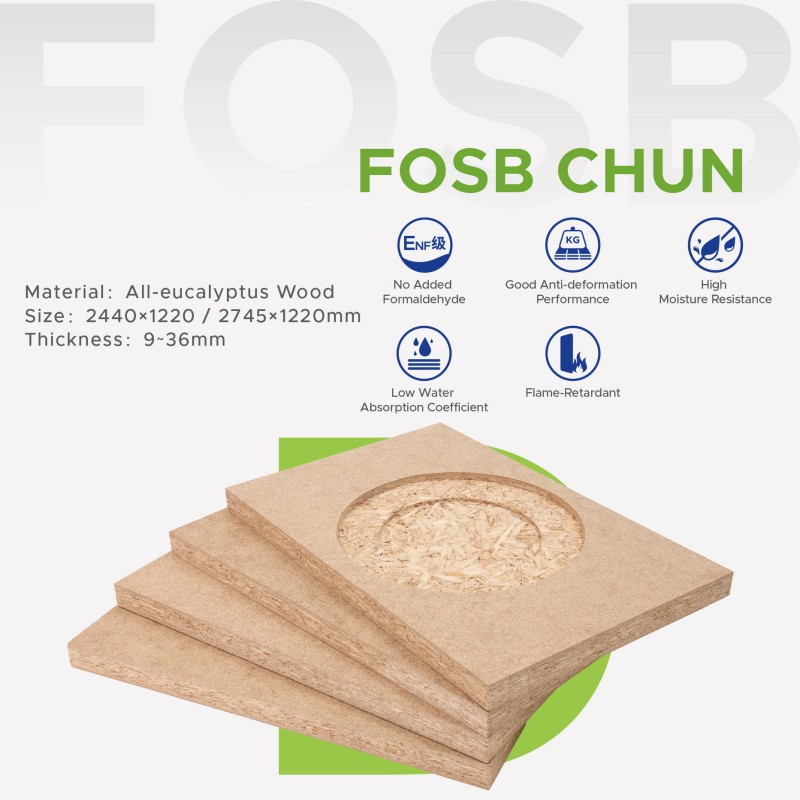
Fire performance customization has become increasingly important as building codes and safety regulations impose stricter requirements on interior materials, particularly in commercial, institutional, and public assembly spaces. FOSB panels can be customized with fire-retardant treatments that improve flame spread ratings and reduce smoke generation during combustion events. These treatments typically involve chemical additives incorporated during panel manufacturing or applied as surface treatments that modify the material's combustion characteristics without significantly affecting other performance properties or aesthetic qualities.
B2B buyers specifying FOSB panels for regulated environments can request products certified to meet specific fire safety standards such as ASTM E84 (Class A, B, or C ratings), EN 13501-1 (Euroclass classifications), or regional building code requirements. Custom fire-rated FOSB panels enable manufacturers to expand their market reach into sectors with stringent safety requirements including hospitality, healthcare, education, and transportation infrastructure. Additionally, achieving fire safety certifications through material customization often proves more cost-effective than applying fire-resistant coatings or installing protective barriers during construction, streamlining project timelines and reducing overall installation costs while ensuring compliance with applicable regulations.
Acoustic customization of FOSB panels addresses growing demand for noise control solutions in open-plan offices, educational facilities, healthcare environments, and residential multi-family housing where sound transmission and reverberation management significantly impact occupant comfort and productivity. Custom acoustic FOSB panels incorporate modifications to panel structure, density distribution, and surface treatments that enhance sound absorption or improve sound transmission loss characteristics. Perforated FOSB panels with precisely engineered hole patterns and backing materials create effective sound absorption systems when installed as wall panels, ceiling elements, or freestanding acoustic barriers.
Density optimization and core structure modifications can also improve the acoustic isolation properties of FOSB panels when used in partition systems, door assemblies, or floor underlayment applications. B2B specifications can include acoustic performance targets expressed as Noise Reduction Coefficient (NRC) values for sound absorption or Sound Transmission Class (STC) ratings for sound isolation, enabling designers to select appropriate FOSB panel configurations that meet project-specific acoustic requirements. Custom acoustic solutions expand the application range of FOSB panels beyond traditional furniture and cabinetry into specialized architectural systems where environmental quality and occupant wellbeing are primary design considerations.
Healthcare, food service, and educational sectors increasingly require building materials with enhanced hygiene properties that inhibit bacterial growth and facilitate effective cleaning and disinfection protocols. FOSB panels can be customized with antimicrobial treatments that incorporate silver ion technology, copper compounds, or other biocidal agents that continuously suppress microbial colonization on panel surfaces. These treatments prove particularly valuable in environments where surface contamination poses health risks or where frequent cleaning with aggressive disinfectants can degrade untreated materials over time.
Custom antimicrobial FOSB panels maintain their protective properties throughout the product lifecycle, unlike topical disinfectant applications that require regular reapplication. B2B buyers serving healthcare facilities, commercial kitchens, or cleanroom environments can specify antimicrobial performance levels and request certification documentation demonstrating efficacy against specific pathogen categories. Surface customization for enhanced cleanability, such as non-porous laminate selections and seamless edge treatments, further supports hygiene objectives by eliminating crevices where contaminants can accumulate and creating surfaces that withstand repeated exposure to cleaning chemicals without degradation or discoloration.
For B2B buyers managing high-volume production operations or multi-phase construction projects, batch consistency and quality control customization become critical factors ensuring predictable performance and visual uniformity across extended supply timelines. Custom quality control protocols can include enhanced dimensional tolerance verification, surface quality inspection criteria beyond standard specifications, and documented testing of mechanical and environmental performance properties for each production batch. These customization options provide manufacturers with greater confidence in material consistency, reducing rejection rates and minimizing production disruptions caused by material variability.
FOSB panels can be customized with batch identification systems that enable traceability throughout supply chains and finished product lifecycles, supporting quality assurance programs and facilitating warranty administration. Custom sampling and testing frequencies can be negotiated with suppliers to provide statistical confidence in material properties while balancing inspection costs against risk mitigation objectives. For projects with critical color-matching requirements, custom color verification protocols using spectrophotometric measurement ensure that surface finishes remain within specified color tolerances across multiple production runs and different manufacturing facilities, maintaining brand consistency and aesthetic quality standards throughout product portfolios.
Packaging and logistics customization addresses the practical challenges of transporting, storing, and handling FOSB panels within B2B supply chains, particularly for international shipments or just-in-time manufacturing environments. Custom packaging solutions can include moisture-barrier wrapping for panels destined for humid climates, reinforced corner protection for high-value finished panels, and pallet configurations optimized for specific shipping containers or warehouse storage systems. Panel quantity per package, package dimensions, and pallet stacking patterns can be customized to maximize shipping efficiency, reduce damage during transit, and facilitate efficient unloading and material flow within manufacturing facilities.
Custom labeling systems incorporating QR codes, RFID tags, or batch identification information enable automated inventory management and support lean manufacturing principles by providing real-time material tracking and consumption monitoring. For B2B buyers operating multiple manufacturing sites or managing complex project logistics, custom packaging with site-specific or project-specific identification markings reduces material handling errors and streamlines material distribution to appropriate production lines or installation locations. Returnable packaging systems represent another customization option for high-volume, ongoing supply relationships, reducing packaging waste and associated disposal costs while supporting corporate sustainability objectives.
B2B markets increasingly require comprehensive documentation demonstrating compliance with environmental standards, health and safety regulations, and industry-specific performance certifications. Custom certification packages can include third-party verification of formaldehyde emission levels meeting CARB Phase 2 or E0 standards, FSC or PEFC chain-of-custody documentation verifying responsible forestry practices, and product-specific Environmental Product Declarations (EPDs) quantifying lifecycle environmental impacts. These customized documentation packages enable B2B buyers to satisfy green building certification requirements such as LEED, BREEAM, or WELL Building Standard, expanding market opportunities and supporting corporate sustainability commitments.
Custom technical data sheets with project-specific performance data, installation guidelines tailored to particular applications, and warranty documentation with customized terms and conditions provide additional value to B2B relationships. For international markets, customized documentation in local languages and compliance with regional regulatory frameworks facilitate market entry and reduce administrative burdens associated with product approval processes. Suppliers offering comprehensive, customized documentation services differentiate themselves in competitive B2B markets by reducing customer risk and simplifying the specification process for architects, designers, and procurement professionals.
Evaluating customization options for FOSB panels requires systematic cost-benefit analysis that considers not only direct material costs but also impacts on manufacturing efficiency, quality consistency, market positioning, and lifecycle value. Premium customization options such as exotic veneer surfaces, complex edge profiling, or specialized performance treatments typically command higher unit prices, but may deliver disproportionate value through differentiation, reduced secondary processing costs, or access to higher-margin market segments. Conversely, dimensional customization that reduces material waste or eliminates secondary cutting operations may generate cost savings that offset customization charges while improving production efficiency.
B2B buyers should evaluate customization investments across their entire value chain, considering how upstream material customization impacts downstream manufacturing processes, inventory management complexity, and customer satisfaction. For example, pre-finished FOSB panels with custom laminate surfaces eliminate lamination equipment requirements and reduce manufacturing floor space needs, potentially justifying higher material costs through capital expense avoidance and production capacity optimization. Similarly, custom packaging that reduces handling damage and improves material flow may generate savings in quality control costs and production disruptions that exceed packaging customization premiums. Strategic customization decisions align material specifications with broader business objectives including market differentiation, operational efficiency, sustainability goals, and total cost of ownership optimization.
Customization feasibility and economic viability often depend significantly on order volumes, supplier capabilities, and relationship dynamics between B2B buyers and FOSB panel manufacturers. Many customization options require minimum order quantities that justify tooling investments, production line setup costs, or material procurement for specialized inputs. Understanding supplier minimum order thresholds and negotiating framework agreements that aggregate demand across multiple projects or product lines can make otherwise economically prohibitive customization options viable for mid-volume B2B buyers.
Long-term supplier partnerships enable more extensive customization possibilities as suppliers gain confidence in recurring demand patterns and can amortize customization investments across extended relationships. Collaborative product development relationships where FOSB panel suppliers engage early in B2B buyers' product design processes often yield innovative customization solutions that deliver competitive advantages while remaining technically and economically feasible. Transparent communication regarding volume commitments, specification stability, and order forecasting helps suppliers optimize their production planning and pricing structures, potentially unlocking customization options or pricing concessions that improve value for both parties in the supply relationship.
Strategic customization of FOSB panels can serve as a powerful tool for market differentiation, enabling B2B buyers to deliver unique product attributes that resonate with end customers and command premium pricing or market share advantages. Custom aesthetic treatments, performance enhancements, or sustainability credentials embedded at the material level become integral product features that competitors cannot easily replicate without similar supply chain investments. For example, furniture manufacturers offering collections featuring custom-printed laminates with exclusive designer patterns create differentiated product lines that justify higher retail prices and build brand identity in competitive markets.
Customer value creation through FOSB panel customization extends beyond aesthetic differentiation to include functional innovations that solve specific customer problems or enhance user experiences. Antimicrobial surfaces in healthcare furniture, enhanced acoustic performance in office systems, or improved moisture resistance in bathroom cabinetry represent customization-enabled value propositions that address concrete customer needs and expand addressable market opportunities. B2B buyers who strategically align FOSB panel customization decisions with target customer value drivers create sustainable competitive advantages that resist commoditization pressures and support long-term business growth across evolving market conditions.
Lead times for custom FOSB panels vary considerably depending on customization complexity, order volume, and supplier production schedules. Simple customizations such as non-standard dimensions or density specifications typically add one to two weeks to standard production timelines, while complex surface treatments, specialized performance modifications, or custom laminate printing may require four to eight weeks or longer. High-volume orders often justify dedicated production runs that can actually reduce per-unit lead times compared to small custom orders that must be scheduled around larger standard production batches. B2B buyers should engage suppliers early in project planning phases to understand realistic lead times for specific customization requirements and establish framework agreements that provide predictable delivery schedules for recurring custom specifications.
Minimum order quantities for custom FOSB panels reflect the economic realities of production setup costs and material procurement for specialized inputs. Dimensional customizations typically carry the lowest minimum order requirements, often starting at single pallet quantities or 50-100 panels depending on supplier policies. Surface treatment customizations involving custom laminate patterns, specialized coatings, or unique veneer selections usually require substantially higher minimums, potentially ranging from 500 to 5,000 panels to justify printing plate production, coating formulation development, or specialty material procurement. Performance modifications such as fire-retardant treatments or acoustic enhancements may have intermediate minimums reflecting the batch processing nature of treatment applications. B2B buyers can sometimes aggregate demand across multiple projects or negotiate consignment arrangements where suppliers maintain inventory of custom specifications based on forecasted demand patterns, effectively reducing effective minimum order quantities for individual shipments.
Yes, FOSB panels can be extensively customized to match specific brand colors and finishes through various surface treatment options including custom-printed laminates, color-matched coatings, and specialized finishing techniques. Suppliers equipped with digital printing capabilities can reproduce virtually any color, pattern, or graphic on laminate surfaces bonded to FOSB panels, enabling precise brand color matching and even photographic image reproduction. For painted or coated FOSB panels, custom color formulation services can match proprietary brand colors specified by Pantone codes, RAL numbers, or physical color samples, ensuring consistency across product lines and marketing materials. The color-matching process typically involves sample approval stages where B2B buyers verify color accuracy under various lighting conditions before authorizing full production runs. While custom color matching increases lead times and may carry premium pricing compared to standard finish selections, it provides powerful branding opportunities and product differentiation capabilities particularly valuable in competitive consumer-facing markets.
Custom FOSB panels can achieve various sustainability certifications depending on raw material sourcing, manufacturing processes, and environmental performance characteristics. Forest Stewardship Council (FSC) or Programme for the Endorsement of Forest Certification (PEFC) chain-of-custody certifications verify that wood fibers used in FOSB panels originate from responsibly managed forests, with custom documentation provided for specific projects or product lines requiring certified materials. Formaldehyde emission certifications including CARB Phase 2 compliance, European E1 or E0 standards, and various national regulations can be documented for custom FOSB panel specifications, supporting green building requirements and indoor air quality objectives. Some suppliers offer Environmental Product Declarations (EPDs) for custom FOSB panel configurations, providing lifecycle assessment data that quantifies environmental impacts and supports LEED, BREEAM, or other green building certification processes. Additionally, custom FOSB panels can incorporate recycled content, bio-based adhesives, or other environmentally preferable materials with appropriate certification documentation, enabling B2B buyers to align material specifications with corporate sustainability commitments and market differentiation strategies based on environmental credentials.

Copyright © 2026 GuangXi Dekek Group.All rights reserved.
 EN
EN


 Hot News